Showing posts with label Wednesday Word. Show all posts

Wednesday, October 14, 2015

Wednesday Word: Enmity

Enmity
noun en·mi·ty \ˈen-mə-tē\

1 : positive, active, and typically mutual hatred or ill will

Origin of ENMITY
Middle English enmite, from Anglo-French enemité, enemisté, from enemi enemy
First Known Use: 13th century

This word is used in the Bible, and I came across it in my studies the other day. To be at enmity with someone is to be at odds with them. The use of the word "hatred" in the Merriam-Webster definition above would seem to be a bit harsher than I would normally attribute to this word.

Another definition would be: the state or feeling of being actively opposed or hostile to someone or something.

That is more in line with what I intend when I use this word.

Wednesday, October 7, 2015

Wednesday Word: Apathy

Apathy
noun ap·a·thy \ˈa-pə-thē\

1 :  lack of feeling or emotion :  impassiveness
2 :  lack of interest or concern


As many of you know, I am battling a sense of apathy at my local library.

To update you, I sent an email to our mayor and asked to be appointed to the Library Board. Of course, and I should have considered this, the board specifics are governed by the Code of Alabama, and our mayor is tied by its binds.

So, I asked him to send to me a list of the current members, and the minutes from the last two meetings. I also listed a number of things that could be implemented without regard to funding. He promised to speak to the library director about these items.

I will keep you posted!

Wednesday, September 23, 2015

Wednesday Word: Respite

Respite
noun re·spite \ˈres-pət also ri-ˈspīt, British usually ˈres-ˌpīt\

1:  a period of temporary delay
2:  an interval of rest or relief

Origin of RESPITE
Middle English respit, from Anglo-French, from Medieval Latin respectus, from Latin, act of looking back
First Known Use: 13th century
 
Another word that I love, and think should be used more often in conversation.
 
This word came to mind this past weekend, as I attended a caregiver seminar at my church. One of the points made again and again is that caregivers need a time of respite. It can be very stressful to be a caregiver and often becomes all-consuming.
 
A time of respite, away from the tasks at hand, will refresh and renew both your body and mind.
 
I'll bet you could use some respite right now!

Wednesday, September 16, 2015

Wednesday Word: Cacophony


A barking dog, a crying baby, loud music, slamming doors, sirens, alarms, repetitive sounds of all kinds, the cacophony of a room full of people talking; ... Kelli Jae Baeli


Cacophony
noun ca·coph·o·ny \ka-ˈkä-fə-nē, -ˈkȯ- also -ˈka-\

1:  harsh or discordant sound :  dissonance
2:  harshness in the sound of words or phrases

1650-60; < New Latin cacophonia < Greek kakophōnía

This is a very interesting word. As you can see from the picture above, the term inherently points to a negative connotation. Too many harsh noises sounded together at once to become an overwhelmingly unbearable sound.

However, there are other ways to look at this word. For example, when I had three boys all under the age of one year, their cries could become a cacophony of hunger. When I am feeding my little rescue cats, their meows are what we call a "CATcophony". Before an orchestra plays, and the musicians are warming up, the sound is definitely a cacophony of instrument sounds.

I look at this word as less of a negative, and more of a description of a variety of different sounds, bumping into one another and bouncing off into waiting ears.

Friday, September 11, 2015

Wednesday Word: Preventative

Preventative

adjective or noun pre·ven·ta·tive \-ˈven-tə-tiv\

Definition of PREVENTATIVE

:  preventive
Now, what we have here is a perfect example of how the language changes over time. When you look up a word and the definition is another word, that usually means that the initial word is not the preferred term. As a matter of fact, it may not even be a word, but its usage has become so common and accepted that the dictionary has included it in the lexicon.
 
For example, several years ago you would not have found the word "irregardless" in the dictionary. It is there today, referring you to the correct term "regardless".
 
So it is with "preventative". It's not actually a word, but it has become so commonly (mis)used that it is now accepted.
 
However, be a friend of grammar and do not use it. Use the correct "preventive" instead.
 
Oh! Here is the definition and etymology of preventive:
 
a :  designed or serving to prevent the occurrence of disease <preventive medical care>
b :  undertaken to forestall anticipated hostile action
 

First Known Use of PREVENTIVE

circa 1626 

Wednesday, September 2, 2015

Wednesday Word: Behoove

Behoove

verb be·hoove \bi-ˈhüv, bē-\

to be necessary, proper, or advantageous for

I can completely see how using this word too often would get annoying. It's not a word that you hear very often, and yet, it has a clear and certain meaning.

When talking to my kids: It would behoove you to get home by midnight.

When talking to my boss: It would behoove you to look at the report I sent on the sales figures.

When talking to my husband: It would behoove you to remember our anniversary.

See how it is used? Now you try!

Wednesday, August 26, 2015

Wednesday Word: Karma


Karma

Sanskrit karma fate, work
First Known Use: 1827
 
: the force created by a person's actions that some people believe causes good or bad things to happen to that person
 
Remember last week's Wednesday Word, Schedenfreude? It means feeling delight in someone else's misfortune. I cautioned against that, and used this week's word as an example. Karma.
 
See, Karma holds that what you have done to others will eventually be done to you. Hinduism and Buddhism takes the Christian Golden Rule a step farther here. Kind of like a cosmic balance.

Wednesday, August 19, 2015

Wednesday Word: Schadenfreude


Schadenfreude
scha·den·freu·de often capitalized \ˈshä-dən-ˌfrȯi-də\

German, from Schaden damage + Freude joy
First Known Use: 1895

: a feeling of enjoyment that comes from seeing or hearing about the troubles of other people

There is a LOT of schadenfreude going on lately, isn't there? People getting pleasure from the misfortune of others.

The lastst I can think of is one of the Dugger sons has been caught in a marital affair. People seem absolutely delighted that he has committed such a public sin. The other example is Jarod from Subway fame has been caught having/wanting/soliciting sex with minors. Again, people seem to thrill at the news of his downfall.

Remember when Michael Phelps smoked marijuana and it was all over social media? We loved that!

Why are we like this? Because it makes us feel better to see others around us fail in such spectacular ways. But be careful. Next week's word: karma.

Wednesday, August 12, 2015

Wednesday Word: Careen

Careen

verb ca·reen \kə-ˈrēn\

to go forward quickly without control

This is probably not a new word to you, but it is one that we just don't use enough. I think most often of an out-of-control vehicle: The car careened off the road.

At my age, though, the ultimate careen was forever solidified in a few seconds of footage of ski jumpter Vinko Bogataj on the Wide World of Sports:


Week after week for years, American's saw this as the "agony of defeat" as the show opened. Thank goodness, Vinko was okay, and lived a quiet life in his home country of Yugoslavia.

He careened down that hill. And probably careen a bit when he tried to walk away from it.  

Wednesday, August 5, 2015

Wednesday Word: Egregious


Egregious

adjective egre·gious \i-ˈgrē-jəs\

very bad and easily noticed

Origin of EGREGIOUS
Latin egregius, from e- + greg-, grex herd
First Known Use: circa 1534

I love using this word. It means that it's bad; just terrible; the worst.
Outstandingly bad.

His behavior at school was acceptable, but at home it was egregious.

His misuse of "I" and "me" was egregious.

Wednesday, July 29, 2015

Wednesday Word: Halcyon

Halcyon
hal·cy·on \ˈhal-sē-ən

noun
a bird identified with the kingfisher and held in ancient legend to nest at sea about the time of the winter solstice and to calm the waves during incubation

adjective
very happy and successful

Love words with more than on definition, and these are so very different! I am going to use the adjective.

While reading Harper Lee's "Go Set a Watchman", I smiled at the use of halcyon. Not a very common word, it is easily worked into a sentence, and will make others lift impressed eyebrows.

There are a few weeks of halcyon weather between a Deep South spring and summer.

The halcyon water was calming after a hard day.

Wednesday, July 22, 2015

Wednesday Word: Salubrious

Salubrious

adjective sa·lu·bri·ous \sə-ˈlü-brē-əs\

Origin of SALUBRIOUS

Latin salubris; akin to salvus safe, healthy
 
First Known Use: 1547

While this word may look a little fancy and off-putting, it is really just a fancy way of saying that something is good for you.

Exercise of the mind and body are salubrious.

Often people with tuberculosis moved to a more salubrious climate.

See? Now YOU try!

Wednesday, July 15, 2015

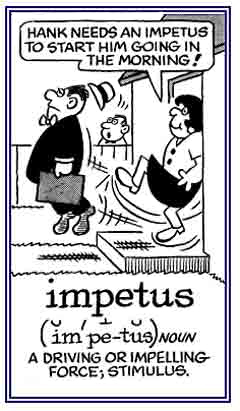
Wednesday Word: Impetus

Impetus
\ˈim-pə-təs\
 
1a (1) :  a driving force :  
b :  stimulation or encouragement resulting in increased activity
 
2:  the property possessed by a moving body in virtue of its mass and its motion —used of bodies moving suddenly or violently to indicate the origin and intensity of the motion
 
 
I like to use this word as it appears in the first definition, as a sort of "cause and effect" description. For example: The man's impetus to quit smoking was the birth of his grandchild.
 
This is a very straightforward word, and I am not sure why it is not used more often. Perhaps you will use this as an impetus to start using it in your everyday vocabulary!
 

Wednesday, July 8, 2015

Wednesday Word: Detritus

Detritus
\di-ˈtrī-təs\

1:  loose material (as rock fragments or organic particles) that results directly from disintegration
2:
a :  a product of disintegration, destruction, or wearing away :  debris
b :  miscellaneous remnants
 
This past Sunday, my pastor used this word in his sermon. I was horrified to find that I have been pronouncing this word incorrectly! I put the emphasis on the first syllable as opposed to the second syllable; and, gave it a short 'i', as opposed to a long 'i'.
 
 
So, when you refer to the remnants of something, like used children's toys bound for the dumpster, you will be able to tell your kids to put the detritus in the garbage.

Wednesday, July 1, 2015

Wednesday Word: Prattle

Image result for prattle

Prattle

\ˈprat-liŋ, ˈpra-təl-iŋ\

verb

To talk at length in a foolish or nonsensical way.

I love this word because it is not commonly used, and could be used ... a lot. Do you know that person who goes on and on and on about something, when the conversation is completely exhausted? Next time, you can say, in a loving way, "Oh, my! How you do prattle on."

Just make sure it is not YOU who may be prattling.


Wednesday, June 24, 2015

Wednesday Word: Pregnant

preg·nant
ˈpreɡnənt/
adjective
adjective: pregnant
  1. 1.
    (of a woman or female animal) having a child or young developing in the uterus.
    "a pregnant woman"
     
  2. 2.
    full of meaning; significant or suggestive.
    "a pregnant pause"
    synonyms:full of, filled with, charged with, heavy with, fraught with, replete with, rich in, abounding in

My grandmother used this word quite a bit when I came to her with an idea. "That is a pregnant idea!" she would exclaim! I thought this was so funny, and I came to love this usage of the word. The word "pregnant" is full of meaning and conjures quite a full, robust mental image. I think it would be a pregnant idea to use this word more often!


Wednesday, June 17, 2015

Wednesday Word: Fisticuffs

fisticuffs

fist·i·cuffs
ˈfistiˌkəfs/
noun
plural noun: fisticuffs
  1. fighting with the fists.

I LOVE this word! You can certainly say many other common words in its place, like "it came to blows", "they started fighting", "he hit the other man". However, nothing really captures the feel of the moment more than saying, "It finally came to fisticuffs!" See? Don't you love this??

Wednesday, June 10, 2015

Wednesday Word: Indelible

in·del·i·ble
inˈdeləb(ə)l/
adjective
adjective: indelible
  1. (of ink or a pen) making marks that cannot be removed.
    synonyms:ineradicable, permanent, lasting, ingrained, persisting, enduring, unfading, unforgettable, haunting, never to be forgotten
    "indelible memories"

I remember a story of Estee Lauder visiting one of her makeup counters and overhearing a customer asking a sales associate how long a lipstick would wear. The associate told the customer that it was practically indelible. Ms. Lauder interrupted, and corrected her. "If it were indelible, my dear, I would never sell more."

I love this word. It is so clear in its meaning, yet very rarely used. Make it an indelible part of your vocab today!

Wednesday, June 3, 2015

Wednesday Word: Pariah

pa·ri·ah
pəˈrīə
noun
noun: pariah; plural noun: pariahs
  1. an outcast; a person who is hated and rejected by other people
    "they were treated as social pariahs"
     
  2. historical
    a member of a low caste in southern India.
1610s, from Portuguese paria or directly from Tamil paraiyar, plural of paraiyan "drummer" (at festivals, the hereditary duty of members of the largest of the lower castes of southern India), from parai "large festival drum."  Applied by Hindus and Europeans to any members of low Hindu castes and even to outcastes. Extended meaning "social outcast" is first attested 1819. Online Etymology Dictionary
 
I write an article once a month for the local newspaper. Topics vary, but it's always an opinion piece. Since I live in a very small town in the deep south, my opinions are very often at odds with my neighbors. Because of this, I find that I am often a pariah.

Wednesday, May 27, 2015

Wednesday Word: Opine

Image result for opine

o·pine

ōˈpīn/
verb
formal
verb: opine; 3rd person present: opines; past tense: opined; past participle: opined; gerund or present participle: opining
  1. hold and state as one's opinion.
    "“The man is a genius,” he opined"

I was part of a conference call the other day where someone used this word. She used it correctly, but it made me realize that there is a tendency to use this as a synonym for "lament":


la·ment

ləˈment/
noun
noun: lament; plural noun: laments
  1. 1.
    a passionate expression of grief or sorrow.

Lament is a statement of one's opinion, but it is limited to grief or sorrow. You may also use it as "complaining", as in the song I sang in high school choir, "Alto's Lament", which is a song about an alto who longs to sing melody for a change from harmony.

Opine, on the other hand, is an expression of any opinion. "This pizza is wonderful!" he opined. "Her skirt is too short," she opined.

"We should use this word more often," she opined.