Showing posts with label holocaust. Show all posts

Saturday, August 27, 2016

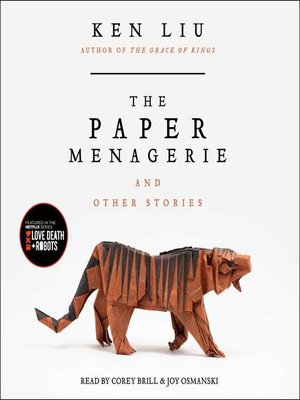
The Paper Menagerie and Other Stories by Ken Liu

Summary:
 With his debut novel, The Grace of Kings, taking the literary world by storm, Ken Liu now shares his finest short fiction in The Paper Menagerie. This mesmerizing collection features all of Ken’s award-winning and award-finalist stories, including: “The Man Who Ended History: A Documentary” (Finalist for the Hugo, Nebula, and Theodore Sturgeon Awards), “Mono No Aware” (Hugo Award winner), “The Waves” (Nebula Award finalist), “The Bookmaking Habits of Select Species” (Nebula and Sturgeon award finalists), “All the Flavors” (Nebula award finalist), “The Litigation Master and the Monkey King” (Nebula Award finalist), and the most awarded story in the genre’s history, “The Paper Menagerie” (The only story to win the Hugo, Nebula, and World Fantasy awards).
 
A must-have for every science fiction and fantasy fan, this beautiful book is an anthology to savor.

My take: 5 looks

It took me a while to read this one because I had to pause at the end of each story, sometime for days, to think about it, mentally study it, and allow it to enter my memory stores where it wanted to reside. The stories are varied in length, are wide in range and subject, and are all unforgettable.

When I started with "The Bookmaking Habits of Select Species", I knew this would be unlike anything I'd read lately. And it just got better from there. A sly combination of history lesson, science fiction, revisionist history, and social commentary, Liu deserves every award and accolade he has received for this compilation, which are numerous.

I highly recommend this gem. Here are a few memorable quotes:
  • "We have always faced a precarious existence, suspended in a thin strip on the surface of this planet between the fire underneath and the icy vacuum above." Mono No Aware
  • "The desire to freeze reality is about avoiding reality." Simulacrum
  • "...a boy stands in darkness and silence. He speaks; his words float up like a bubble. It explodes, and the world is a little brighter, and a little less stiflingly silent." A Brief History of the Trans-Pacific Tunnel
 Thanks to NetGalley for an advanced copy of this book in exchange for my honest opinion.

Saturday, June 11, 2016

Sonata for Miriam by Linda Olsson

Summary:

Linda Olsson's first novel, Astrid & Veronika, introduced readers to her gorgeous prose, and her extraordinary understanding of human relationships. With her second novel, she once again charts that terrain in a novel that also explores the significant impact of history on individual lives. In Sonata for Miriam, two events occur that will change composer Adam Anker's life forever. Embarking on a journey that ranges from New Zealand to Poland, and then Sweden, Anker not only uncovers his parents' true fate during World War II, but he also finally faces the consequences of an impossible choice he was forced to make twenty years before-a choice that changed the trajectory of his life.

My take: 2 looks

A disappointment from one of my favorite authors. While the writing and structure are absolutely beautiful, the story and characters left me with no sympathy and no desire to get to know them better, as well as very little understanding of what the purpose of the story was.

Adam is grieving the death of his daughter, which happens very early in the story. He is grieving, but we seem to get in on the end of it because there is no sense of heart-wrenching, brokenness, or despair. Instead, I was left with the feeling that since a main aspect of Adam's life was now gone, he simply needed to replace it with something or someone else. And the story centers around this search.

Toward the end of the book, we switch to Cecilia's voice. The woman who gave up her child with no valid explanation. And we never understand why. We never understand what this grief is that Adam claims she has. She comes across as very self-serving, self-absorbed, and everyone panders to her.

All in all, this book is a collection of beautifully crafted sentences and paragraphs, which have nothing at all to say. Not recommended.

Saturday, February 13, 2016

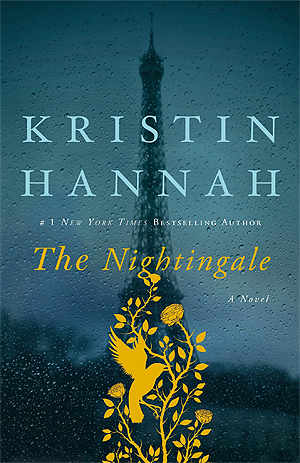
The Nightingale by Kristin Hannah

The NightingaleSummary:

In the quiet village of Carriveau, Vianne Mauriac says goodbye to her husband, Antoine, as he heads for the Front. She doesn’t believe that the Nazis will invade France...but invade they do, in droves of marching soldiers, in caravans of trucks and tanks, in planes that fill the skies and drop bombs upon the innocent. When France is overrun, Vianne is forced to take an enemy into her house, and suddenly her every move is watched; her life and her child’s life is at constant risk. Without food or money or hope, as danger escalates around her, she must make one terrible choice after another.

My take: 4 looks

This is historical fiction at its best. Here is a story of bravery, family, adversity, struggle, and at the heart of it all, a father and two sisters. The backdrop is World War II Paris, but WWII by no means takes center stage here.

In a publishing world where WWII and Holocaust books are prevalent, The Nightingale shows the raw humanity and evil on both sides. There are decisions as tough as Sophie's Choice, and brutality as real as Schindler's List. Hannah traverses these roads deftly as the reader is taken into the villages, hillsides, waiting in rationing lines, and seeing everything you've ever loved and worked for pillaged at the hands of the enemy. At the same time, there is hope, there is family, there is love, and there is a driven desire to do what is right.

I wept at the end of this book. I loved every moment of this wonderfully beautiful story. Highly recommended.

Tuesday, June 9, 2015

The Book of Aron by Jim Shepard

Summary:
From the hugely acclaimed National Book Award finalist, a novel that will join the shortlist of classics about the Holocaust and the children caught up in it. Aron, the narrator, is an engaging if peculiar young boy whose family is driven from the countryside into the Warsaw Ghetto. As his family is slowly stripped away from him, Aron and a handful of boys and girls risk their lives, smuggling and trading things through the "quarantine walls" to keep their people alive, hunted all the while by blackmailers and by Jewish, Polish, and German police (not to mention the Gestapo). Eventually Aron is "rescued" by Janusz Korczak, a Jewish-Polish doctor and advocate of children's rights famous throughout prewar Europe who, once the Nazis swept in, was put in charge of the ghetto orphanage. In the end, of course, he and his staff and all the children are put on a train to Treblinka, but has Aron managed to escape, to spread word about the atrocities, as Korczak hoped he would? 

My take: 2 looks
The buzz on this book was so great that I downloaded it almost the day it was released. It is more of a novella, at 166 pages on my e-reader. Honestly, if it had been much longer, I would not have finished it.

I have several issues with the story. First of all, I have to question the reason it was written. It has been done before, by many, by those who actually experienced it. If Shepard wanted to tell how the Holocaust affected a young person, we have The Diary of Anne Frank. If he wanted to present real life in the Warsaw ghetto, we have The Diary of Mary Berg. If he wanted to present it in a novel form, we have Jacob the Liar. Something for children, maybe? There is Milkweed.

So, you see, if you write a book about life for a Jew during the second world war, you'd better bring something new to the table. Shepard doesn't, in my opinion.

The story is told first-person from the point of view of Aron, not yet a teen when the Warsaw ghetto is sectioned off. Because of this, I assume, the narrative is very disjointed and fragmented. Ideas and descriptions are left hanging, and there are rather abrupt changes in flow and subject. In giving the author the benefit of the doubt, I would say that this is the way a boy in the ghetto would think. However, it would have been more effective if there had been a flow in the beginning, loosening and losing structure as Aron is affected by his circumstances.

There were many superfluous items in the story that were never fully developed. Why was his relationship with his father strained? Did his father treat all of the children that way, or just Aron? What became of Boris and his desire to kill Aron? What was the profound effect that must have existed because of Aron's forced friendship with Lejkin?

There are so many wonderful books which cover this tragic time in history. I cannot recommend this one.

Sunday, April 13, 2014

The Chosen by Chaim Potok

Summary:
A classic story of two fathers and two sons and the pressures on all of them to pursue the religion they share in the way that is best suited to each. And as the boys grow into young men, they discover in the other a lost spiritual brother, and a link to an unexplored world that neither had ever considered before. In effect, they exchange places, and find the peace that neither will ever retreat from again....

My take: 3 stars
A book about two boys becoming young men, their fathers and how they relate to them, and growing up under the same, but vastly different, religion.

This book is full of symbolism, from the baseball game which begins the book, to the eye issues experienced by both young men, to the emerging of a new nation, and hence, two new young men.

However, maybe a little too much symbolism. It is heavy-laden and prime for themes, studies and analyses. On the surface, it is an intricate story of interwoven lives and faiths. In discussion, it becomes The Mariana Trench. My college-age son reports to me that, regardless of the assignment in Literature classes, he always uses this book for his theme.

I think the most important role of this book, written in 1967, is not the relationships presented, but the religions. In a time when Judaism was not widely experienced or understood in America, very little was pervasively known about Orthodoxy versus Hasidism. Potok describes each in detail and from the inside out. History is revealed, and the ideologies of the two sects are described, as well as lived out by the characters, making the understanding of them almost palatable.

The birth of the nation of Israel is overshadowed by the personal stories, but acts all the same as a climax to the novel as it sets the stage for an exciting and dangerous future for Jewry worldwide.

I think less should be spoken of about the symbolism of the book and more about the trailblazer that Potok becomes in bringing two sides of a very foreign and ancient religion to the American masses. I learned more about the history, beliefs and ideals of Judaism from this book than ever before.

Highly recommended.

Monday, April 7, 2014

Unbroken by Laura Hillenbrand

Summary:
On a May afternoon in 1943, an Army Air Forces Bomber crashed into the Pacific Ocean and disappeared, leaving only a spray of debris and a slick of oil, gasoline, and blood.  Then, on the ocean surface, a face appeared.  It was that of a young lieutenant, the plane’s bombardier, who was struggling to a life raft and pulling himself aboard.  So began one of the most extraordinary odysseys of the Second World War. The lieutenant’s name was Louis Zamperini.  In boyhood, he’d been a cunning and incorrigible delinquent, breaking into houses, brawling, and fleeing his home to ride the rails.  As a teenager, he had channeled his defiance into running, discovering a prodigious talent that had carried him to the Berlin Olympics and within sight of the four-minute mile.  But when war had come, the athlete had become an airman, embarking on a journey that led to his doomed flight, a tiny raft, and a drift into the unknown. Ahead of Zamperini lay thousands of miles of open ocean, leaping sharks, a foundering raft, thirst and starvation, enemy aircraft, and, beyond, a trial even greater.  Driven to the limits of endurance, Zamperini would answer desperation with ingenuity; suffering with hope, resolve, and humor; brutality with rebellion.  His fate, whether triumph or tragedy, would be suspended on the fraying wire of his will.

My take: 4 looks
This one gets four looks because it is a true story, the man survives, and he is a hero. However, Hillenbrand would be best served with a harsher editor. While the story is unbelievable riveting, the text is redundant, verbose and, many times, unnecessary.

For example, the fact that these young soldiers were immature and unseasoned is repeated again and again in copious stories of draining CO2 from life jackets to make soda, taking a dare to fly into a storm, and ignoring sage advice of superiors. We get it. They were young and cocky. Strike a few pages here and there and get on with the meat of the story. If felt at times that Hillenbrand may get paid for the word.

If you don't mind skimming, this is an excellent story of the human spirit and one man's desire to live despite the odds.

Recommended.

Tuesday, March 4, 2014

Life After Life by Kate Atkinson


Summary:
What if you could live again and again, until you got it right? On a cold and snowy night in 1910, Ursula Todd is born to an English banker and his wife. She dies before she can draw her first breath. On that same cold and snowy night, Ursula Todd is born, lets out a lusty wail and embarks upon a life that will be, to say the least, unusual. For as she grows, she also dies, repeatedly, in a variety of ways, while the young century marches on towards its second cataclysmic world war. Does Ursula's apparently infinite number of lives give her the power to save the world from its inevitable destiny?

My take: 4 looks
Wonderful...just wonderful.

No longer the most original premise for a book (see Replay by Ken Grimwood and 11/22/63 by Stephen King), this book builds a compelling story by putting a new spin in that the protagonist has no memory of the past when coming back as an infant.

Each chapter follows the birth and subsequent death of Ursula. I loved the way Atkinson built on each "life" by referring to past events, people and occasions. The weaving of decisions taking Ursula on different paths was so well done that it was seamless, causing a smile to come to my lips as I saw tragedy averted, only to be faced with a new crisis.

The age-old question is explored: if you could do it over again, would you? Much like King's take on the future if JFK had not been assassinated, the reader is struck by how events can be dramatically altered with the slightest change in the decision.

Beautifully written and a breath of fresh air in a land of zombies and vampires, I highly recommend this book.

Saturday, January 18, 2014

Those Who Save Us by Jenna Blum

Summary:
For fifty years, Anna Schlemmer has refused to talk about her life in Germany during World War II. Her daughter, Trudy, was only three when she and her mother were liberated by an American soldier and went to live with him in Minnesota. Trudy's sole evidence of the past is an old photograph: a family portrait showing Anna, Trudy, and a Nazi officer, the Obersturmfuhrer of Buchenwald. Driven by the guilt of her heritage, Trudy, now a professor of German history, begins investigating the past and finally unearths the dramatic and heartbreaking truth of her mother's life. Combining a passionate, doomed love story, a vivid evocation of life during the war, and a poignant mother/daughter drama, Those Who Save Us is a profound exploration of what we endure to survive and the legacy of shame.

My summary: 3 looks

My F2F seems to love reading books dealing with WWI and the holocaust. This book, however, was different in that it dealt with the German side of the equation. What did the Germans go through and tolerate who were left in the cities that the Nazis decimated? To what lengths would they go to in order to feed their families and protect their children? This book tells the story nicely.

**SPOILERS**

However, I wanted more resolution at the end between the mother and daughter. I wanted to know why Anna refused to talk to Trudy. Why did Trudy change the spelling of her name? Would she ever know truly who her father was and what happened to him? Why did the townspeople dislike Trudy so, even to the point of disgracing her after Jack's funeral? What happened to the cameraman after the project was complete?

This book could almost have a sequel, for all of the unanswered questions. However, there isn't enough story left to justify another book; just may unanswered questions.

With that in mind, my rating is 3 instead of 4 looks. It was a very enjoyable book, but I could have used about 50 more pages to tie up loose ends. Recommended.

Saturday, July 13, 2013

The Storyteller by Jodi Picoult

Summary:
Some stories live forever . . .

Sage Singer is a baker. She works through the night, preparing the day’s breads and pastries, trying to escape a reality of loneliness, bad memories, and the shadow of her mother’s death. When Josef Weber, an elderly man in Sage’s grief support group, begins stopping by the bakery, they strike up an unlikely friendship. Despite their differences, they see in each other the hidden scars that others can’t, and they become companions.

Everything changes on the day that Josef confesses a long-buried and shameful secret—one that nobody else in town would ever suspect—and asks Sage for an extraordinary favor. If she says yes, she faces not only moral repercussions, but potentially legal ones as well. With her own identity suddenly challenged, and the integrity of the closest friend she’s ever had clouded, Sage begins to question the assumptions and expectations she’s made about her life and her family. When does a moral choice become a moral imperative? And where does one draw the line between punishment and justice, forgiveness and mercy?

In this searingly honest novel, Jodi Picoult gracefully explores the lengths we will go in order to protect our families and to keep the past from dictating the future.

My take: 4 looks
This is my second Jodi Picoult novel, and my favorite so far. My book club read this one, and I don't know what I expected, but I drawn into the story completely and found the writing to be very nice.

Sage Singer, at first, was a bit over-the-top for me, but as her story unfolded throughout the novel, so did my understanding of and compassion for her. This is a young lady with serious issues on several fronts, and Picoult handled the complexity of the story beautifully. Monster or Human? Forgive or not? Questions that all of us face at one time or another, in varying degrees, that enables the reader to complete submerge into the story.

I loved the common thread of baking bread throughout the novel. The descriptions were so lovingly painted that I could see, smell and taste the dough. Bread is vital in so many ways to the story and I completely fell in love with the art of breadmaking.

Excellent writing, excellent story and highly recommended.

Sunday, March 10, 2013

The Book Thief by Markus Zusak re-read

I read this book for the first time February 2011. Here is my review at that time:
  • Very interesting premise. Death narrates the story of a small town in Germany during WWII. The characters are well-developed and the story is compelling. I'm not sure what I would change in order to make this a favorite, but I found it easy to put down at the end of the day. I doubt I will think of the book in the coming days, as it makes it way through me, as I do with those listed as my favorites. Nevertheless, I would most definitely recommend it.
What a short and concise, very non-emotional response to this book.

After reading it this time, I am struck. Or perhaps I should say ... stricken ... Posted on my Shelfari group:
I just finished The Book Thief and my heart is so heavy that I am simply going to have to go to bed and dream of feather hair, Jesse Owens, accordion players and the humanity of death.

My review this time: 5 looks and a heart

First of all, the narrator. Death is omnipresent and the most reliable of storytellers. I would call Death a "he" in that I read his words with a masculine voice, for some reason. He is deeply affected by human, by humanity and by The Book Thief, in particular. His statements are true, profound, amusing and utterly heart-gripping. He moves through WWII with a heavy heart, if that is possible. He is delicate and gentle with the souls he takes. He correlates the color of the sky as he takes soul after soul. He doesn't look at the people left behind, but busies himself with other sights, because those left behind haunt him. This is Death.

Next is Liesel, The Book Thief.  A young girl who is intimate with death, loss, love, fear ... far too many emotions for an eleven-year-old. Suffice it to say that she has lost everything she has ever loved.

The supporting characters are few, and very richly drawn. The first 400 pages of the book draws you into their lives and gives the reader the feeling of spending two years with them as Germany finally starts its fall. Some may find this slow-moving, but I felt that the superb writing and emotions elicited in the last third of the book make the detail well worth it. The reader truly becomes a character, as well.

Please, read this book. Buy it so you can read it again and again. Highlight passages and make notes. Buy it for a friend and invite them to do the same. It is deeply affecting and highly recommended.

Saturday, February 9, 2013

My Enemy's Cradle by Sara Young

Summary:
Cyrla's neighbors have begun to whisper. Her cousin, Anneke, is pregnant and has passed the rigorous exams for admission to the Lebensborn, a maternity home for girls carrying German babies. But Anneke's soldier has disappeared, and Lebensborn babies are only ever released to their father's custody-- or taken away. A note is left under the mat. Someone knows that Cyrla, sent from Poland years before for safekeeping with her Dutch relatives, is Jewish. The Nazis are imposing more and more restrictions; she won't be safe there for long. And then in the space of an afternoon, life falls apart. Cyrla must choose between certain discovery in her cousin's home and taking Anneke's place in the Lebensborn-- Cyrla and Anneke are nearly identical. If she takes refuge in the enemy's lair, can Cyrla fool the doctors, nurses, guards, and other mothers-to-be? Can she escape before they discover she is not who she claims? Mining a lost piece of history, Sara Young takes us deep into the lives of women living in the worst of times. Part love story and part elegy for the terrible choices we must often make to survive, MY ENEMY'S CRADLE keens for what we lose in war and sings for the hope we sometimes find.

My take: 3.5 looks
This was a very easy book to read. And yet, it was a very difficult story to take in. The writing was exceptional, drawing me in from the beginning. The characters were very sympathetic and real and the situations in which each found themselves were harrowing.

I had no idea that there truly were Lebensborn facilities during the war; but it makes perfect sense, knowing what we now know about how the Nazi regime thought and worked. The fact that these women had a place to go for excellent care and safety was a good thing, but the fact that many of these children were taken from the beginning to be raised as potential soldiers seemed as cold as a munitions factory. I was also saddened by the lack of physical contact for the babies, and wonder how that affected those who survived the war into adulthood.

I liked the characters immediately. Of course, Anneke and Cyrla were irritating as almost all late-teen girls are. They were perhaps to little too naive and full of wanderlust for the tone of the story, especially given Anneke's mother and father's stern dispositions, and Cyrla's difficult past. I would have thought that, realistically, they would have been more subdued and in touch with the reality of war. I became irritated over and and over by Cyrla's persistent refusal to see the danger she was in.

Karl and Isaac were excellent characters on both sides of the spectrum. One loving and forthright, a Nazi soldier. The other a Jew, but very stoic and stiff with people.

This was a very humanizing story and intriguing part of history that I want to learn more about. A great read, and highly recommended.  

Sunday, August 26, 2012

The Guernsey Literary and Potato Peel Pie Society by Mary Ann Shaffer

Summary:
Written with warmth and humor as a series of letters, this novel is a celebration of the written word in all its guises, and of finding connection in the most surprising ways.

My original review, July 3, 2009: 4 looks
This book started slowly for me. However, once I truly entered the worlds of Juliet, Dawsey, Amelia and Elizabeth...I was enamored. And to feel these two worlds, nee, three worlds, come together was as sweet to me as any freshly plucked fruit. Presented as letters, telling the story of people, relationships, situations and war...my trip to Guernsey was a lovely one.

Today's review: 5 looks
It's not often that a book will cause me to re-read. This book was even more delightful the second time around. Perhaps it is the three year lapse between readings, but I found the characters, setting and story to be fresh.

I want to be Juliet! She is smart, winsome, unpretentious and follows her heart. My friend Debbie gave me the greatest compliment when, as she was reading the book, texted to tell me that I WAS Juliet to her!What an altogether lovely thing to say.

The format of letters telling the story is a unique one, and tends to put people off a bit, but there is a natural rhythm in the reading; and, while it is heavy with characters, the story lines are so clearly followed that I experienced no confusion at all. I began jotting down names and attributes in the beginning but quickly abandoned this as unnecessary.

I am increasing my review from 4 looks to 5 because this is a delightful read, a treasure to own, one that I will read again, and highly recommend.

Sunday, August 12, 2012

The Covenant by Naomi Ragen

Summary:
Living in terror-torn Jerusalem, Elise Margulies constantly fears for the safety of her loved ones. Confined to bedrest during a difficult pregnancy, she happily awaits the return of her husband and little girl from a ballet recital, only to find that her worst fears have finally been realized. All seems lost until a phone call to her grandmother in America unexpectedly revives a decades-old oath, creating a force that transcends time and place, to rescue her loved ones. Over the course of five terror- and hope-filled days, the ties that bind two generations forge a potent alliance against contemporary evil.

My take: 4 looks
This is a beautifully written account of present-day Jewish and Arab relations. You see and feel all sides: Jews with no ties to their past, practicing Jews in Israel, and survivors of the Holocaust reunited after years apart. On the other hand, there are Arabs who are active and violent members of Hamas, their unsuspecting wives, children, aunts, who are true Muslims, seeking only peace, and those who are walking the thin line between the two.

There is love, hatred, family, traitors, terror, intrigue, death and birth. Highly recommended.

Monday, March 19, 2012

Zoli by Colum McCann

Summary:
A unique love story, a tale of loss, a parable of Europe, this haunting novel is an examination of intimacy and betrayal in a community rarely captured so vibrantly in contemporary literature.

Zoli Novotna, a young woman raised in the traveling Gypsy tradition, is a poet by accident as much as desire. As 1930s fascism spreads over Czechoslovakia, Zoli and her grandfather flee to join a clan of fellow Romani harpists. Sharpened by the world of books, which is often frowned upon in the Romani tradition, Zoli becomes the poster girl for a brave new world. As she shapes the ancient songs to her times, she finds her gift embraced by the Gypsy people and savored by a young English expatriate, Stephen Swann.

But Zoli soon finds that when she falls she cannot fall halfway–neither in love nor in politics. While Zoli’s fame and poetic skills deepen, the ruling Communists begin to use her for their own favor. Cast out from her family, Zoli abandons her past to journey to the West, in a novel that spans the 20th century and travels the breadth of Europe.

Colum McCann, acclaimed author of Dancer and This Side of Brightness , has created a sensuous novel about exile, belonging and survival, based loosely on the true story of the Romani poet Papsuza. It spans the twentieth century and travels the breadth of Europe. In the tradition of Steinbeck, Coetzee, and Ondaatje, McCann finds the art inherent in social and political history, while vividly depicting how far one gifted woman must journey to find where she belongs.

My take: 4 looks
I was surprised at how easy to read this book was. It dealt with an interesting topic, at an interesting time, but the epic nature of the novel and the potential to be dry was a red flag for me.

Not to worry. The writing was excellent, with full-bodied characters. I have heard of Gypsies all my life, but have never been introduced to their lifestyle, culture, traditions and past like McCann has done in this book. Zoli was a complex character, torn between two very different worlds. I felt her pain and struggle as she moved through the years. The book divisions were welcome and at appropriate times. Emotions were almost at a crescendo as one section stopped and another one started. While the action and chronology were fluid, each section allowed for a breath and a new start as I turned the page.

I highly recommend this book, and look forward to reading more works by Colum McCann.

Saturday, September 10, 2011

Sarah's Key by Tatiana de Rosnay


Summary:
Paris, July 1942: Sarah, a ten year-old girl, is brutally arrested with her family by the French police in the Vel’ d’Hiv’ roundup, but not before she locks her younger brother in a cupboard in the family's apartment, thinking that she will be back within a few hours. Paris, May 2002: On Vel’ d’Hiv’s 60th anniversary, journalist Julia Jarmond is asked to write an article about this black day in France's past. Through her contemporary investigation, she stumbles onto a trail of long-hidden family secrets that connect her to Sarah. Julia finds herself compelled to retrace the girl's ordeal, from that terrible term in the Vel d'Hiv', to the camps and beyond. As she probes into Sarah's past, she begins to question her own place in France, and to reevaluate her marriage and her life. Tatiana de Rosnay offers us a brilliantly subtle, compelling portrait of France under occupation and reveals the taboos and silence that surround this painful episode.

Sometimes I think the summaries give too much information. But I suppose you also can't simply judge a book by its cover. This book has been made into a movie (poster above) for French cinema and is being converted to English this year.

My review: 4 Looks
The parallel stories of a family caught up in the 1942 roundup of French Jews and a present-day journalist who finds her life intertwines with that of one of the victims. The story goes back and forth between the two stories until they eventually converge at the apartment where it first began. Written with honesty and sensitivity, I think this will make a great movie.

Thursday, August 11, 2011

Night by Elie Wiesel

Summary: In Nobel laureate Elie Wiesel's memoir Night, a scholarly, pious teenager is wracked with guilt at having survived the horror of the Holocaust and the genocidal campaign that consumed his family. His memories of the nightmare world of the death camps present him with an intolerable question: how can the God he once so fervently believed in have allowed these monstrous events to occur? There are no easy answers in this harrowing book, which probes life's essential riddles with the lucid anguish only great literature achieves. It marks the crucial first step in Wiesel's lifelong project to bear witness for those who died.


My review: 5 stars
I don't really know what to say about this book. It was so sobering. So gritty and real. So horrendous and angry.

We must NEVER forget.