It was pointed out to me that I rated The Great Santini by Pat Conroy 2 looks while another member of my reading group rated it at 5. I certainly noticed the disparity in reviews, but now I realized that others see it, too.
That has me thinking: Why do I review books the way I do. Am I being fair? Am I looking at objective or subjective criteria? Do I rate on writing/subject matter/story telling? Here is what I have come up with.
It depends on my mood.
I am human, of course, and when I read a book, there are a lot of external factors intertwining with my thought processes and reception of the characters, story and events in the book. I have to acknowledge this first and foremost. I am not a reading robot.
I like good writing.
At first I was concerned that I was putting too much emphasis on whether or not I liked the story and not enough emphasis on the writing. The man with whom I had a review chasm, as stated above, commented that The Great Santini was southern writing at its best. I heartily disagree with this. Great Southern writers to me are Carson McCullers, Flannery O'Conner and Zora Neale Hurston. More contemporary authors to elevate to this status (in my opinion) would include Alice Walker, Jesmyn Ward, and Fannie Flagg.
While Conroy writes in an easy-to-read manner, I found his style to be a bit overbearing, redundant and predictable, using Santini as my source for this. I got bogged down a number of times in his descriptions (a basketball game lasts 10 pages, for example).
I don't care if the story is negative or positive.
It would be a travesty to review a book based solely on whether or not it left me feeling happy. Books should challenge your view (like every day by David Levithan), make a statement about something (like any of Carl Hiaasen's books dealing deftly with the environment), bring a new perspective (like The Scavenger's Daughters by Kay Bratt), or offer good, old fashioned escape (James Patterson, anyone?).
Finally, do I think of the book after it's finished?
I have been known to go back and increase the looks I give a book because it haunts me well after I have read it. Examples of this would be Life After Life by Kate Atkinson, People of the Book by Geraldine Brooks, and Chasing Francis by Ian Morgan Cron. These books impact me, and that is the sign of a good book.
All-in-all, I remain comfortable in my reasons for rating books. One to Five Looks is not a great system because there are A LOT the threes. It's not terrible, but it's not great. Some threes are better than others, but I think that is going to be the case with any limited system.
Yep, Santini is still a two.
Friday, June 27, 2014

Thursday, June 26, 2014
The Great Santini by Pat Conroy

The moving portrait of a son’s struggle to escape the iron fist of his volatile military father.
Marine Colonel Bull Meecham commands his home like a soldiers’ barracks. Cold and controlling but also loving, Bull has complicated relationships with each member of his family—in particular, his eldest son, Ben. Though he desperately seeks his father’s approval, Ben is determined to break out from the Colonel’s shadow. With guidance from teachers at his new school, he strives to find the courage to stand up to his father once and for all.
Inspired by Conroy’s own relationship with his father, The Great Santini is a captivating and unflinching portrayal of modern family life and a moving story of a son becoming a man.
My take: 2 looks
***SPOILERS***
This was a heartbreaking book to read. Knowing that it was based on Pat Conroy's own childhood made it that much more morose.
Bull Meechum is a mean man. He sets out to hurt others, and if he isn't successful doing it with words, he will do it physically. I kept looking for a redemption here. In books like this, where difficult relationships are portrayed, there is a moral, allegory, metaphor, something that the reader takes away with them at the last page. I searched and searched for such a quality in this one and could come up with only one thing: this was a purge for Conroy.
With that said, I despised this man. His antics at the beginning of the book with the cream of mushroom soup set up his maturity level, and everyone knows that a pubescent boy has no self-control. That is what Bull was mentally: a surly, spoiled, over-compensating teenager. To find abuse of new recruits a form of entertainment is sad enough, but to intentionally get your son drunk on his birthday over his objections, yell taunts at him during basketball games, and run "military exercises" in your home with a real sword is just over the top.
Likewise, I found the wife willfully weak and enabling. She was a strong Southern woman one minute, and lamenting to the verge of whining about what her life used to be, and what it had become. The excuses she made for her husband's bad behavior were infuriating and the fact that she didn't protect her children was inexcusable the next. I agonized over the children and the lasting effects the verbal and physical abuse would have on their lives.
The ending frustrated and annoyed me. I wanted Bull to live into old age, to become ineffectual and to see himself replaced with the next generation of Marine. Likewise, I wanted to see his children leave home and never look back. To have him die just after the prime of his life was beyond the pale for me, and robbed me of any redeeming value of the novel.
It is well written, and easy to read. However, feeling that this is merely a publishing of a document that Conroy's therapist may have had him write as part of therapy, I can't recommend it.
Saturday, June 21, 2014
Choosing Sophie by Leslie Carroll

When life throws you a curve ball... Venus deMarley has just been hit with a wild pitch. At forty she's finally found the perfect fiancé, when Sophie—the daughter she gave up for adoption twenty years ago—suddenly reappears. Venus has another crisis on her hands as well: her eccentric millionaire dad just died and willed her his pet project—a rag-tag minor league baseball team called the Bronx Cheers— if Venus and Sophie can reconcile and once again become a family. Venus knows diddly about sports, but Sophie's a jock, unlike her glamorous mom. And after two decades apart, these two women know nothing about each other, and rarely agree on anything. But maybe—just maybe—they have more in common than they think...
My take: 3 looks
Entertaining read, and I read it in one sitting, by the pool. While it was a bit predictable and there were some loose ends, I enjoyed it for what I call a "palette cleanser". Chick lit, and nothing to cause great discussion, it's the story of the reuniting of a mom and the daughter she gave up for adoption 20 years prior. The zinger here is that there is a minor league baseball team in the picture, willed to the woman if she can reunite with her daughter. The requisite family-bad-blood is there, but never totally resolved (what happened to Linda's attitude toward Olivia - I refuse to call her "Venus", did Marty ever grow up...that kind of thing).
I was reminded of the movie released in the last few years starring Clint Eastwood and Amy Adams, "Trouble with the Curve", where a daughter is instrumental in turning a baseball team around. It's the same kind of story here, but with a mother and daughter. All-in-all, it was a pleasant read and I will probably read more by this author.
Recommended.
Haiku Mama by Kari Anne Roy

When she was my mom she said no sweets before lunch. Hypocrite grandma. This collection of irreverent haiku explores the reality of modern motherhood complete with dirty diapers, spilled Spaghetti-Os, obnoxious purple dinosaurs, car seats, strollers, choking hazards, and more. It's the perfect gift for new moms with young children at home a book that can be picked up for a minute and then put down to wipe a nose or settle an argument, all while making Mom laugh. With more than 100 haiku and 40 whimsical illustrations, Haiku Mama is a collection of verse that all mothers (and their family and friends) will love.
My take: 5 looks
Hilarious!
I will admit to being a serious word-nerd, and I have written my own Haiku in a black Moleskine notebook since 2010. Various expressions of happiness, sadness, frustration, and stress. 17 syllables can say so much, but you have to have a good imagination to get your feelings into that limited amount of text.
I fully appreciate every Haiku presented in Haiku Mama. They are funny, clever, and so very true. Some of my faves:
Awake so early,
small boy rises with the sun.
Can't snooze a baby.
Like badge of honor
our spreading hips unite us:
asstacular moms
Every one of these will cause a smile to come to your face, a nod of agreement, or the explosive, "Amen, sister!".
High recommended.
Friday, June 20, 2014
Shaken by J. A. Konrath

Chicago cop Jacqueline "Jack" Daniels has chased, and caught, dozens of dangerous criminals over the course of her career. But she's about to meet her match. When Jack wakes up in a storage locker, bound and gagged, she knows with chilling certainty who her abductor is. He's called "Mr. K." More than two hundred homicides have been attributed to him. His victims have died in the most horrible ways imaginable. He's the essence of evil. Some think he's just an urban legend. But he's real. Jack has tangled with him twice in the past, and both times he managed to slip away. Now Jack will finally have a chance to confront the maniac she's been hunting for over twenty-five years. Unfortunately, it won't be on her terms. In less than two hours, Mr. K is going to do to Jack what he's done to countless others. And Jack is going to learn that sometimes the good guys don't win...
My take: 3 looks
WOW. As the seventh book in this series, I should know by now that Konrath doesn't always tie up all loose ends. And BOY, he really doesn't with this one.
Unlike the other in the Jack Daniels series, this is a non-linear story, bouncing between three periods: 25 years ago, three years ago and today. The common thread is the killer(s) and their relationship with Jack. It was also, in my opinion, a little more gruesome than the others. The killers here were a little more ... I'll say inventive ... in their torture and killing of victims. As much as I want to see how the story ends (#8 in the series is the last, according to Konrath), I think I will have to wait a little until the bile that stayed in my throat throughout reading this one settles a little.
If you've read the others in the series, you will, of course, have to read this one. Recommended beach read.
Thursday, June 19, 2014
Jeanette Winterson Likes Rabbit!

Jeaneatte Winterson is causing quite a stir by capturing, skinning, preparing and eating a rabbit. All while tweeting the process. Nothing went to waste, though. She fed the entrails to her cat. There's a picture of that, too.
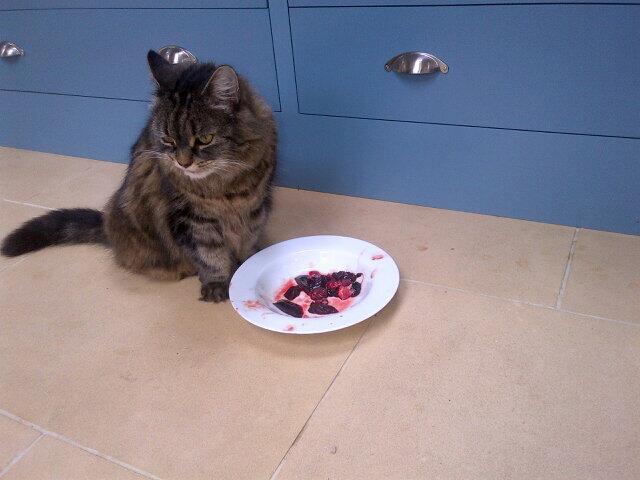 Why is this so outrageous to people? I can see if vegetarians are opposed to this. Seeing Thumper partially eviscerated is exactly the reason they don't eat meat. A friend of mine years ago told me that she would not eat "anything with a face". Hmmm.
However, what is wrong with everyone else, who eat meat anyway? You know what it is? They don't want to know where that steak comes from. They don't want to see the long, floppy ears that go into their rabbit stew. I get that, I guess. However, being harsh to Ms. Winterson online is a bit uncalled for. Especially if they are being so blatantly hypocritical.
Not one to back down from a fight, however, she meets fire with fire. Responding and retorting to the harshest, asking one person who promised to "unfollow" her if she read only vegetarian authors. That is spunk!
If you want to take pics of your dinner at Ruth's Chris steakhouse, start on the farm. Then follow the cow to the stockyard, and on to the slaughterhouse. That is where you will lose your discomfort as it starts looking less like a pet and more like the item you put on the grill. Acknowledge, as uncomfortable as it is, that something died to feed you.
Wake up, stop being so self-righteous, and pick up a Jeanette Winterson book. She will give you another perspective in more ways than one.
Tuesday, June 17, 2014
Tangled Vines by Kay Bratt

The pain of China’s Cultural Revolution well behind them, Benfu and his treasured Calla Lily are content in their old age surrounded by their family of adopted daughters. Once abandoned, the girls are now cherished members of the Zheng family. Yet there remains an emptiness in their hearts: their only biological daughter, Dahlia, was abducted as a newborn 30 years before. When their daughter Linnea discovers an unexpected clue about what really happened to Dahlia, the elderly couple’s hopes are reignited. Will their search bring their daughter back to them, and are they ready to face the secrets of the past?
My take: 4 looks
Very nice continuation of the Tales of the Scavenger's Daughters series. While the first book was very sweetly written with regard to familial ties, this book deals more with the dark side of relationships.
The progression of the characters is very well done, with the girls getting older, more mature and their situations moving naturally. I also liked the continuing stories of Benfu and Calla Lilly. While this is a stand alone story, reading in the order of the series will make it fuller and more enjoyable.
These are quick books to read, offer ongoing story lines throughout the books, while wrapping up individual stories. Highly recommended.
Monday, June 16, 2014
The Orange Girl by Jostein Gaarder

At fifteen, Georg comes upon a letter written to him by his dying father, to be read when he comes of age. Their two voices make a fascinating dialogue as Georg comes to know the father he can barely remember, then is challenged by him to answer some profound questions. The central mystery of The Orange Girl is the story of an elusive young woman for whom Georg’s father searches in Oslo and Seville—and whom Georg finally realizes is his mother.
My take: 3 looks
Like other Jostein Gaarder books, this one is heavy on philosophy. However, the story is so compelling that you don't even realize that questions of after-life, what-ifs, terminal diseases and moving on after grief are fully addressed.
Georg is fully likable, and a very fleshed-out teenager. His family is supportive and nurturing, while giving him the space he needs to read this letter 11 years after it was written. What follows is a thoughtful, emotional and ultimately tragic story that buds with new life at the end.
Recommended.
Sunday, June 15, 2014
The Scavenger's Daughters by Kay Bratt

Having survived torture and imprisonment during China’s Cultural Revolution, Benfu escaped to find love with his compassionate and beautiful Calla Lily. Together they build a fulfilling life around the most menial of jobs—Benfu’s work collecting trash. As he sorts through the discards of others, he regularly discovers abandoned children. With unwavering determination, he and Calli spend decades creating a family of hand-picked daughters that help heal the sorrow and brighten their modest home. But all is not perfect and when crisis threatens to separate their family, Benfu—or possibly his band of headstrong daughters—must find a way to overcome the biggest hardship yet.
Inspired by a true story, and set against the backdrop of a country in transition, The Scavenger’s Daughters is a sweeping present day saga of triumph in the face of hardship, and the unbreakable bonds of family against all odds.
My take: 4 looks
Very, very nice story! The wonderful premise of a man who has to scavenge for a living, eking out a meager existence from other people's throwaways, finding that daughters are also considered throwaways. With a heart of gold, he and his wife adopt all of these found girls, regardless of age, physical condition and the fact that they can barely feed them. What they have in abundance, however, is love, care, respect and a sense of belonging.
In a day that material possessions seem to define the worth of a person, this story about the love of a family was as refreshing as a koi pond.
Highly recommended.
Sunday, June 8, 2014
Whistling Past the Graveyard by Susan Crandall

Whistling past the graveyard . That’s what Daddy called it when you did something to keep your mind off your most worstest fear. . . . In the summer of 1963, nine-year-old Starla Claudelle runs away from her strict grandmother’s Mississippi home. Starla’s destination is Nashville, where her mother went to become a famous singer, abandoning Starla when she was three. Walking a lonely country road, Starla accepts a ride from Eula, a black woman traveling alone with a white baby. Now, on the road trip that will change her life forever, Starla sees for the first time life as it really is—as she reaches for a dream of how it could one day be.
My take: 3 looks
First and foremost, I adored Eula, the black woman. She was complex, multi-dimensional and evolved nicely throughout the story. While the book is told from Starla's point of view, the story is centered around her relationship with Eula.
With that said, Starla got on my last dead nerve. I felt that Crandall was a little heavy-handed with Starla's rebellion, disobedience, and lack of self-control. Time after time after time, she put others at risk doing exactly what she had been warned not to do, and seemed only marginally regretful when her actions came full circle. While I think Crandall tried to have her maturity evolve over the course of the story, it was too little, too late for me. I got to the point where I thought, "If Starla does that, she deserves what she gets," killing my sympathy for this character.
The fact that it was told from Starla's point of view raises the comparison of Scout from Harper Lee's To Kill A Mockingbird. That is where the comparison ends. Scout is painted with a realistic brush, making rash decisions occasionally, and learning from them. She seems a typical young girl, struggling with what adults expect of her, and what she wants to do. Starla, on the other had, was a frustrating character who didn't seem to learn from her mistakes, even when she realized (too late, always) others would be hurt.
Very fast-paced story, a bit predictable and milquetoast. However, it is a good summer book, and won't bog you down.
Thursday, May 29, 2014
Mudbound by Hillary Jordan

In Jordan's prize-winning debut, prejudice takes many forms, both subtle and brutal. It is 1946, and city-bred Laura McAllan is trying to raise her children on her husband's Mississippi Delta farm—a place she finds foreign and frightening. In the midst of the family's struggles, two young men return from the war to work the land. Jamie McAllan, Laura's brother-in-law, is everything her husband is not—charming, handsome, and haunted by his memories of combat. Ronsel Jackson, eldest son of the black sharecroppers who live on the McAllan farm, has come home with the shine of a war hero. But no matter his bravery in defense of his country, he is still considered less than a man in the Jim Crow South.
It is the unlikely friendship of these brothers-in-arms that drives this powerful novel to its inexorable conclusion. The men and women of each family relate their versions of events and we are drawn into their lives as they become players in a tragedy on the grandest scale.
My take: 3 stars
Typical story of racism in the south after WWII. Black sharecroppers on the land of white owners. Some whites hate blacks and others simply follow the rules because they are the social mores of the day. That is the typical part of the story. The part that sets this book apart is the comparison and contrast of the characters.
The book is written from the perspectives of six characters, half white and half black: Two husbands, two wives, and two war veterans just returned home. The women are the richest and most complex.
Laura is a white wife, who is very submissive to her husband; however, he knows her moods: "A woman will make her feelings known one way or another. Laura's way is with music: singing when she's content, humming when she isn't, whistling tunelessly when she's thinking a thing over and deciding whether or sing or hum about it."
In contrast, Florence is the black wife of a man who tends the land that he doesn't own. She is a headstrong midwife and let's her husband know where she stands: "You'll move if I say so", Hap (her husband) said. "For the husband is the head of the wife, even as Christ is the head of the church." Florence's reply: "Only so long as he is alive. For if the husband be dead the wife is loosed from his law. Says so in Romans."
Henry and Hap are the husbands, one owns the land and the other works it. Jamie and Rosnel are both war veterans, and are dealing with their war-damaged psyches in different ways.
There is one character who overshadows all of these, however, and we never get to hear from him. It's Pappy, the cruel racist father of Henry and Jamie, who lives with Henry and family. While I detested Pappy, his ways and his words, Jordan draws a very real character from this time, and I wanted to hear from him. What made him so hateful? Was he always mean? Did something happen in his life to set his ways, and his path on one of hate-filled vitriol? Why didn't we hear from him? Why would Jordan choose to make one of the most pivotal characters silent? It was disappointing.
As was the last chapter, told by Rosnel. It was full of "what if" scenarios. I got the feeling that Jordan assumed the reader would want to know how Rosnel, out of all of the other characters, turned out. With me, this was not the case. Laura started the book, the book was really about her at its core, and I think Laura should have been the one to close it. To have Rosnel close it seemed needless and cast a hint of preference on the closing. It gave him an unnecessary spotlight at the end that marred the story.
Tuesday, May 27, 2014
Suzanne's Diary for Nicholas by James Patterson

Katie Wilkinson's boyfriend Matt dumps her; not a total cad, he leaves her a gift, a diary kept by Suzanne, his first wife, for their son Nicholas. Though it's not exactly the diamond ring Katie was hoping for, she's unable to make herself destroy the diary-against her better judgment, Katie begins to read. Drawn against her will into the other woman's world, Katie learns of physician Suzanne's heart attack at age 35 and her decision to slow down, accomplished by a move to Martha's Vineyard and a new job as a simple country doctor. When love comes knocking, in the form of housepainter-cum-poet Matt Harrison, Suzanne is ready to listen to her newly repaired heart.
Though painful for Katie, she begins to know and like Suzanne and her infant son Nicholas. Suzanne's devotion to Matt and their son shines through, as well as her plainspoken wisdom. While the journal helps Katie understand Matt, whether they can write a future together remains in question.
My take: 2.5 looks
This is what I call a "palette cleanser": a book that is virtually mindless and requires no thought, but is entertaining nonetheless. Typical chick-lit, the characters are likable, the romance is unrealistic romantic, and the outcome is obvious. This is the perfect beach book, and I recommend it as such.
The Woman Who Knew Gandhi by Keith Heller

Based on an aside in Mahatma Gandhi's autobiography, in which he mentions a brief but seductive youthful flirtation with an Englishwoman, The Woman Who Knew Gandhi boldly imagines a long correspondence between a spiritual leader from the East and an ordinary woman from the West.
In 1948, just after Gandhi's assassination, Martha Houghton receives a letter from Gandhi's son, who himself lies dying of tuberculosis in Bombay. Having found a stash of her letters to his father, he asks to meet her. The request sends Martha into a tailspin, for her husband knows nothing of her lifelong friendship with Gandhi. Martha and her husband are forced to reevaluate their long marriage, and she must find a way to reconcile the disparate halves of her life. Moreover, their small community becomes a magnet for the press, and Martha finds her words twisted and used against her. Ultimately, she must decide whether to meet her old son's friend on his deathbed, or to remain in England and mend the rift in her marriage.
My take: 4 looks
I love accounts like this! One of my favorite books, That Same Flower by Jostein Gaarder, builds on a relationship St. Augustine had before he renounced sensual love. While all of Heller's book is pure speculation, it is told in such a realistic way that the reader is immediately brought into the fantasy.
The book focuses less on Martha's time with Gandhi and more on how his assassination affects her, then the revelation to her husband of her years of friendship with this famous man of peace. Martha receives a letter from Gandhi's son and she is forced to confront what she has hidden for decades. This throws Martha and her husband into a state of reflection, her on the life she could have had; and him wondering how he could have lived this long with his wife and known nothing of his wife's friendship.
Once the news media gets wind of the relationship, they do what the media normally does, distorts the truth until it is unrecognizable. This affects Martha and her family, but that storyline is very secondary to the emotions that each character in the book feels. In the climax, Martha travels to India to confront Gandhi's son on his deathbed.
This book was extremely interesting and I would recommend it.
Monday, May 19, 2014
Author Spotlight: Jostein Gaarder

Jostein Gaarder is quite unlike other authors. From his GoodReads bio:
Jostein Gaarder is, by far, my favorite author. When my husband asked me recently to name a book I would want if deserted on an island, I named Sophie's World, the first novel I read by Gaarder. Written from a child's point of view, as many of his works are, "Sophie" is a novel about the history of philosophy. Gaarder handles this very complex and intricate subject so deftly and through such a compelling story that the reader doesn't realize it meets most requirements for college-level Philosophy 101. It really is quite brilliant.
And then there is Vita Brevis: A Letter to St Augustine, also published in English as That Same Flower. St. Augustine, in his Confessions mentions a woman; the woman whom he renounced in favor of celibacy. The premise here is well-summarized from Wiki: In the introduction, Gaarder claims that he found the old manuscript at a bookshop in Buenos Aires and translated it. According to his plotline, it was written by Floria Aemilia, Augustine's concubine, who after being abandoned by him, got a thorough Classical education, read his Confessions (where she is mentioned but not named, unlike their son, Adeodatus) and felt compelled to write this text as an answer.
Doesn't that make you want to run right out and get it??
The Christmas Mystery is about a boy who opens each day on an advent calendar to find pieces of paper which create a story. The story is about a girl who slowly travels back in time to Bethlehem to see the Christ-child. As the family tries to find the maker of the advent calendar, the story begins to intertwine with their own.
Finally, The Solitaire Mystery. Another story-within-a-story, this one features Hans-Thomas, The Sticky Bun Book, a cross-country adventure to find an estranged mom and a drink of a wonderful liquid called Rainbow Fizz. Again presenting philosophical thoughts and ideas, it is done with more of a light-touch, and the reader doesn't realize at first that they are also on a philosophical journey.
Four of my favorites from this favorite author. Why spotlight him now? Because I just received his The Orange Girl in the mail, and I am exited to read it!
Sunday, May 18, 2014
The Romanov Conspiracy by Glenn Meade

Dr. Laura Pavlov, an American forensic archaeologist, is about to unravel a mystery that promises to shed light on one of the 20th century’s greatest enigmas.
A member of an international team digging on the outskirts of the present-day Russian city of Ekaterinburg, where the Romanov royal family was executed in July 1918, Pavlov discovers a body perfectly preserved in the permafrost of a disused mine shaft.
The remains offer dramatic new clues to the disappearance of the Romanovs, and in particular their famous daughter, Princess Anastasia, whose murder has always been in question. Pavlov's discovery sets her on an unlikely journey to Ireland, where a carefully hidden account of a years-old covert mission is about to change the accepted course of world history and hurl her back into the past; into a maelstrom of deceit, secrets, and lies.
Drawn from historical fact, The Romanov Conspiracy is a high-tension story of love and friendship tested by war, and a desperate battle between revenge and redemption, set against one of the most bloody and brutal revolutions in world history.
My take: 4 looks
Very nice historical novel! The action was steady and realistic, the characters were fully drawn, and the ending was very satisfying.
While the book seemed character-heavy in the beginning, it was necessary to introduce them in short order for the story to properly take off. Meade weaves the story in such a way that each character is separate and distinct and as the story propels, it is easy to keep track of them and their part in the story.
Interestingly, my book club read The Kitchen Boy by Robert D. Zimmerman several months ago, which was painstakingly researched by the author. Many of the people, events, and situations in that book were the same in this book. That period of history is intriguing, and I would highly recommend this book.
Subscribe to:
Posts (Atom)